A UGC campaign is a marketing strategy where a brand uses user-generated content (UGC): photos, videos and reviews made by customers or outside creators instead of its own in-house team. The content runs as organic posts on social media accounts, product pages and, increasingly, as paid ads on TikTok, Instagram and Facebook.
The term means two different things depending on the audience. Brands use it for digital marketing campaigns that invite customers to post, usually around a branded hashtag or challenge. Content creators use it for paid work: a brand sends a brief, a UGC creator makes the video and the brand owns the right to run it. A user-generated content campaign can be either, and many brands now run both at once.
What are the different types of UGC campaigns?
There are two types of UGC campaigns: customer campaigns, where real customers post because they want to or to win something, and paid creator campaigns, where a brand pays creators to make content to a brief. They differ in almost everything except the UGC content itself.
| Customer campaign | Paid creator campaign | |
|---|---|---|
| Goal | Reach, community and social proof | Ad creative to test and scale |
| Who makes it | Customers and fans | UGC creators hired by the brand |
| Cost | Prizes, discounts or nothing | A fee per video, plus usage rights |
| Rights | Asked for post by post, after it's shared | Agreed in the contract before filming |
| Where it runs | Organic social, product pages, the brand's own feed | Paid social media channels (Meta ads, TikTok Spark Ads), organic and TikTok Shop |
| Tools | Collection tools like Greenfly and Bazaarvoice | Creator marketplaces like Billo, JoinBrands and Influee |
Customer campaigns
A customer campaign asks people to post about the product in a way that's easy to find and share, using a branded hashtag, a contest, a challenge or a discount in exchange for a review. A good hashtag is short, unique to the brand and says what to post. The brand then asks each poster for permission before reusing their content.
Paid creator campaigns
The brand writes a brief, hires one or more UGC creators and receives finished videos with the rights to run them. Creators don't need an influencer-size following, because the brand posts the content from its own accounts or runs it as ads. Performance marketers and TikTok Shop sellers often mean this model when they say UGC.
How does a paid UGC campaign work?
A paid UGC campaign runs on a brief: the brand says what it needs, the creator says what they'll deliver and both agree on rights and a fee before anyone films.
Using creators for UGC brand campaigns
Brands find content creators through marketplaces like Billo, JoinBrands and Influee, from their own customer base or via direct outreach. The creator brief should indicate the product, the target audience, the hooks to try, the must-say points and anything that's off-limits, along with the deliverables and the usage-rights window.
Getting UGC campaigns as a creator
Content creators find paid UGC jobs and UGC brand deals on the same marketplaces where brands post briefs and creators apply, or by pitching brands directly with a short portfolio.
Brands hiring UGC creators look for a hook that stops the scroll in the first three seconds, natural on-camera delivery, clean product shots and on-time delivery. Offering more than one video per job (extra hooks, every platform size, a second language) is one clear way to stand out.
What brands ask creators to deliver
| Deliverable | Why it matters to the brand |
|---|---|
| Three hooks over the same video | Ads are won or lost in the first three seconds, so brands test openings |
| 9:16 master plus 1:1 and 4:5 versions | Each placement on TikTok, Reels, Stories and the Meta feed has its own shape |
| Raw files and B-roll | The brand's editors can cut new versions without a reshoot |
| Captions or text on screen | Keeps the message clear for anyone watching without sound |
| A defined usage-rights window | Sets how long and where the brand can run the content as ads |
| Permission for whitelisting or Spark Ads | Lets the brand run UGC-based ads from the creator's own handle |
UGC campaign examples: Gap and Katseye's Better in Denim campaign
On August 19, 2025, Gap premiered Better in Denim, a music-video-style ad starring the pop group Katseye dancing to a re-recording of Kelis' "Milkshake." The spot was built around choreography fans could learn, and they did: people recreated the dance on TikTok and Instagram, including groups at Berkeley and UCLA. The campaign's agency, Invisible Dynamics, reports more than 250,000 pieces of fan-made content. On the company's third-quarter earnings call, Gap CEO Richard Dickson put the campaign's total at 8 billion media impressions and 500 million views and said it drove double-digit growth in denim. The lesson: a customer campaign scales when the brand gives people something specific to copy, like a routine with a clear shape and a song they already know, performed by people the audience already follows.
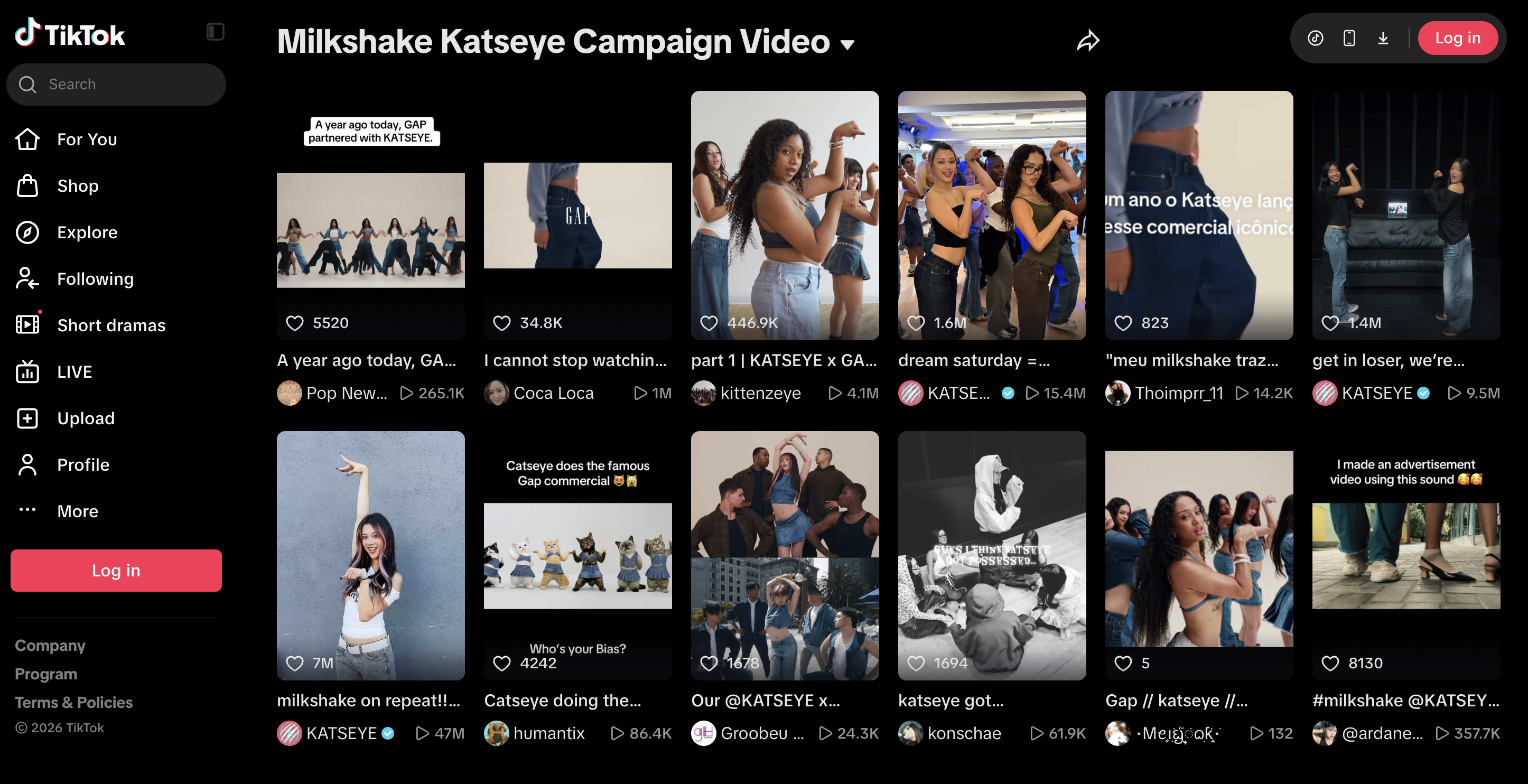
Fan recreations of the Better in Denim dance on TikTok"
How do UGC campaigns handle rights, ads and measurement?
A UGC campaign delivers the most value when the brand has the right to use the content, runs the best of it as ads and measures what it did.
Usage rights
Whoever makes a photo or video owns it until they license it.
For a customer campaign, that means asking posters for permission before reposting or running their post as an ad; collection tools like Greenfly and Bazaarvoice handle the request and keep a record.
For a paid creator campaign, rights go in the contract: where the brand can use the content (organic, paid, website), for how long, in which countries and whether the brand can edit it. When a creator posts the content on their own account, the post is required to have a clear paid-partnership or #ad disclosure.
How to turn UGC into Meta and TikTok ads
There are two routes. The brand can upload the video and run it from its own ad account, which requires only the paid-usage rights. Or it can run the ad from the creator's handle, called whitelisting on Meta and Spark Ads on TikTok, which requires the creator's platform authorization and usually attracts a higher fee.
Setting goals and measuring a UGC campaign
Set one goal per campaign before it starts, then pick the key metrics that match it:
- Awareness: reach, views and, for customer campaigns, the number of posts using the hashtag.
- Engagement: saves, shares and comments per social media post.
- Ad performance: hook rate (the share of viewers still watching after three seconds), click-through rate, cost per purchase and return on ad spend.
- Content value: how many usable assets the campaign produced and what each cost.
Compare UGC ads with the brand's own creative on the same budget and audience to see which performs better.
How to create content for a UGC campaign
To create content for a UGC campaign, start from the brief, then decide whether to shoot real footage, generate it with AI or mix both. Shoot or generate vertical 9:16 clips with a strong first three seconds, capture extra hooks and close-ups, cut one master into platform versions and deliver the files with the usage rights noted.
- Start from the brief. Lock the hook, the product and the must-say points before filming, plus anything the brand can't claim. A creator who reads the brief closely makes fewer reshoots.
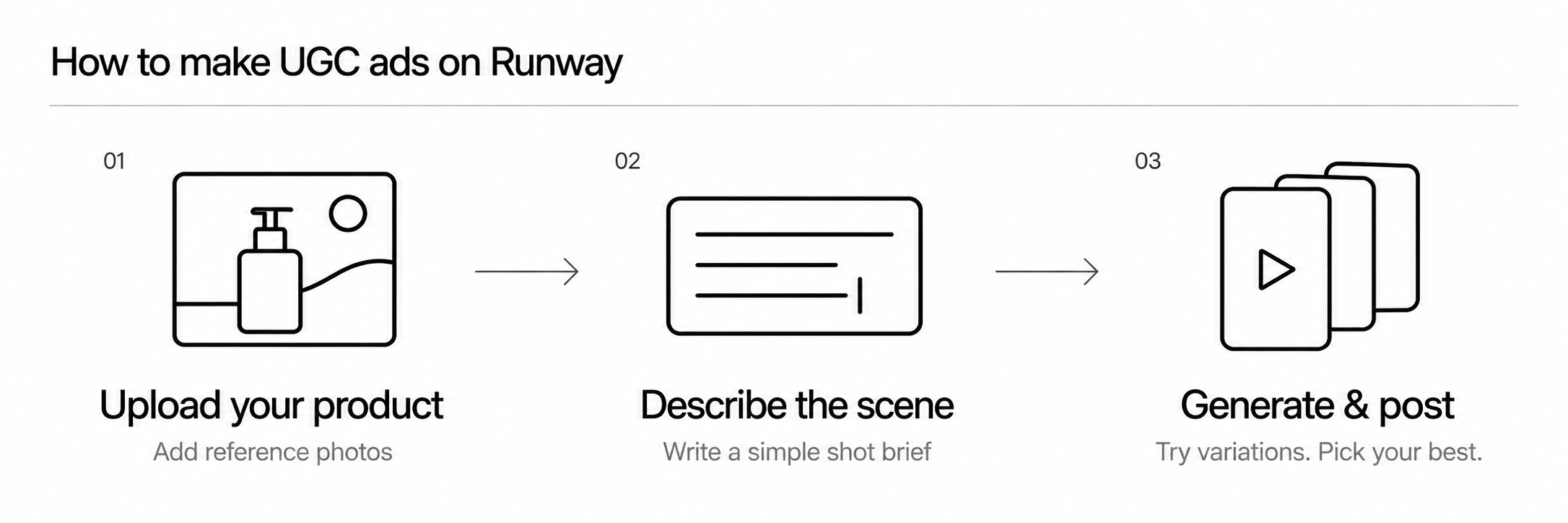
- Choose how to make it (real footage, AI or a mix). A creator on camera gives the ad a real voice and a real experience. AI can make product shots, B-roll and faceless demo footage from product photos with the AI UGC video generator: upload reference images so the product's packaging, colors and logo stay consistent in every generation, then prompt for a handheld 9:16 clip. Many ads mix both: a creator talking to camera, cut with AI-made close-ups. Our AI UGC guide covers where AI-made footage fits in a UGC ad, where it shouldn't and which platform labels apply.
- Plan the shots, then shoot or generate for the platform. UGC ads typically mix talking to camera, hands with the product, close-ups, POV and B-roll, with a voiceover or text on screen. Shoot in 9:16 with a handheld feel, and make the first three seconds count.
- Capture extras. Get product close-ups, a few seconds of B-roll and two or three alternate hooks while the setup is still in place. Extras let one shoot become a set of ads.
- Edit the master, then turn it into versions. Cut one strong master, then make versions for each platform size, each hook and each language.
- Deliver with the usage rights noted. Send the files with a short note covering what's included, what platforms it can run on and for how long.
Try it in Runway. Open Runway Agent with this starter prompt, then swap in your product, setting and hook:
UGC ad starter prompt
Runway Agent/UGC Video Make a 15 second vertical 9:16 UGC style ad for my product. Shot like a real person filming on their phone, quick hook in the first 2 seconds, close up of the product in use, natural light, no captions or watermarks. Ask me for images.
UGC campaign brief template
Brands can tweak and send this, while creators use it to pitch campaigns or check incoming briefs for gaps.
| Field | What to add |
|---|---|
| Brand and product | (add details) |
| Audience | Who the ad is for, in one line |
| Goal | Awareness, ad performance or content library |
| Hook 1 (first 3 seconds) | (sample hook) |
| Hook 2 (first 3 seconds) | (sample hook) |
| Hook 3 (first 3 seconds) | (sample hook) |
| Shots (tick what's needed) | ☐ Talking to camera ☐ Hands with the product ☐ Close-ups ☐ POV ☐ B-roll ☐ Voiceover or text on screen |
| Real footage, AI or a mix | (choose one) |
| Must-say point 1 | (point 1) |
| Must-say point 2 | (point 2) |
| Don't say or show | (no-go areas) |
| Master video length | 15 / 30 / 60 seconds |
| Versions | 9:16 / 1:1 / 4:5 |
| Languages | (add languages) |
| Extras | Raw files, B-roll, alternate hooks |
| Usage rights: where | Organic / paid / website |
| Usage rights: how long | (e.g. 3, 6 or 12 months) |
| Usage rights: countries | (add country) |
| Whitelisting or Spark Ads | Yes / no |
| Fee | (add) |
| Draft due | (add) |
| Final due | (add) |
One creator video, many assets
| Starting point | Versions | Assets |
|---|---|---|
| One 30-second creator video | Three hooks | 3 |
| … in three aspect ratios (9:16, 1:1, 4:5) | 3 × 3 | 9 |
| … in two languages | 3 × 3 × 2 | 18 |
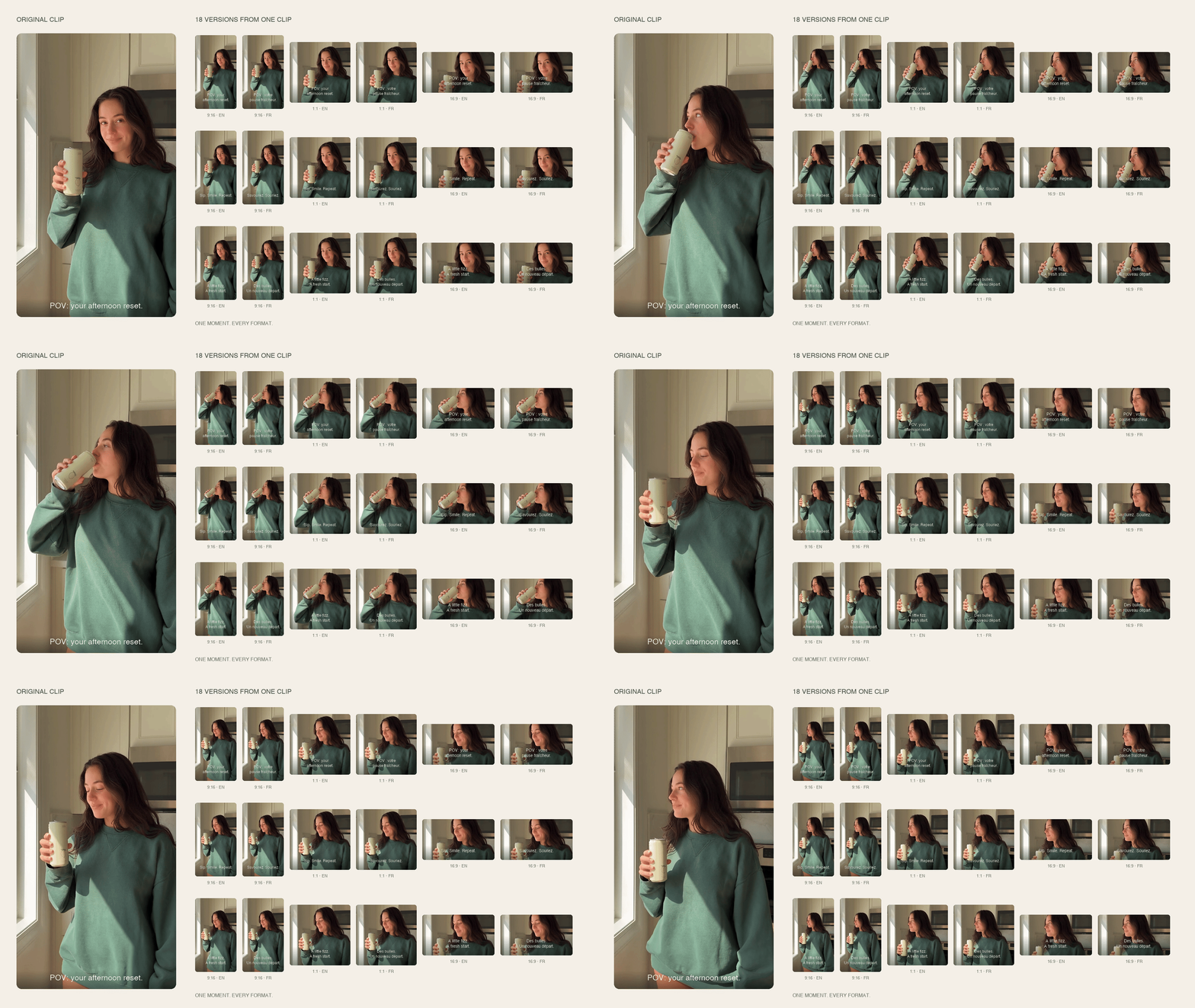
One beverage brand UGC video with 18 variations generated on Runway
Where Runway fits in UGC campaigns
Runway helps both brands and creators make UGC campaign content, whether it starts from real footage, AI clips or a mix. The AI UGC video generator turns product photos into UGC-style 9:16 footage, the Reshoot Product app restages a product shot without a new shoot and the AI video editor edits real creator footage, relights shots or changes backdrops. Runway also adds or fixes voiceovers, lip-syncs and dubs a video into other languages and upscales finished shots, and Runway Agent builds multi-shot sequences.
From there you can resize one master to every platform size and hook variant. For brands, that means more ads from one creator video. For creators, it means delivering a package of versions instead of a single file. Our product video ads page covers polished commercials from a single product photo, and our social media video maker guide covers other tools and content types.
Frequently asked questions
What's the difference between a UGC campaign and influencer marketing?
An influencer campaign pays for an influencer's audience: the influencer posts on their own account and the brand buys their reach. A UGC campaign pays for the content: the brand gets videos it can run from its own accounts and as ads, so the creator doesn't need a large following. Some deals combine both UGC and influencer marketing, with a creator posting the video and licensing it to the brand for ads.
Who owns UGC, and what usage rights should be in the deal?
The creator owns the content until they license it. A paid UGC deal should spell out where the brand can use it (organic, paid ads, their own website), for how long, in which countries and whether the brand can edit it. Treat whitelisting or Spark Ads (where the brand runs ads from the creator's handle) separately, with its own fee. For customer content, ask each poster or brand advocate for permission to reuse it.
How much does a paid UGC campaign cost?
As of October 2026, Billo starts at $99 per video, sold in packs. ppc.io's study of major UGC platforms puts the average single UGC video at about $212, and Billo's own platform data puts it near $198, with established creators charging $500 or more. Extended usage rights, whitelisting, raw files and extra hooks usually add to the fee.
Which UGC platforms are best for beginners?
For brands, marketplaces like Billo, Influee and JoinBrands are the simplest start: post a brief, choose creators and receive finished video content with rights included. For content creators, the same platforms list paid campaigns and don't require a large following, just a portfolio of a few short product videos. Brands that want to collect customer content instead can use tools like Greenfly or Bazaarvoice.
Is UGC still worth it in 2026?
Yes. UGC is still a main format for paid social, because short, phone-shot videos of real people using a product fit how TikTok and Reels look. For brands, the value has shifted toward volume: more hooks and versions to test. For content creators, UGC is a legitimate way to earn from making content without building an audience, and delivering multiple versions along with a master video makes each job worth more.
Can UGC content be static?
Yes. Static UGC includes customer photos posted with a brand's hashtag, written reviews on sites like Yelp and testimonials a brand reposts. The rights rule is the same as for video: ask each poster for permission before reusing their content on product pages, in organic posts or in ads.
What is employee-generated content?
Employee-generated content (EGC) is content that a company's staff create and post about its products, culture and behind-the-scenes work. It's often treated as a type of UGC and is especially common in B2B marketing.
Turn one UGC video into a full campaign
The best UGC campaigns include a master video and its many variations. Edit a creator's footage, add product shots and B-roll, then turn one master into every hook, size and language with Runway, so a single shoot carries an entire campaign. Get started for free.
Related: AI UGC · AI UGC video generator · Best social media video maker