What is a creative AI agent?
A creative AI agent is a system that takes a goal, such as "produce this campaign" or "build this demo reel," and plans a sequence of steps to deliver it, rather than waiting for a new prompt at every stage. Give it a brief and it researches, generates a first pass, checks its own work and hands back something closer to a finished deliverable.
Basic AI tool vs AI creative agent
A basic AI tool takes a single prompt and returns one output. You direct every step: write the prompt, review the result, decide what to try next. Nothing persists between requests, and it doesn’t adapt unless you tell it to.
A creative AI agent takes a brief or goal and plans a sequence of steps to get there on its own. It generates a first pass, reviews its own output and adapts along the way, often producing multiple formats from one instruction. Your role shifts from handling repetitive tasks to reviewing and revising what comes back.
A standard AI tool stops after one output. An agent keeps going.
Types of creative AI agents
Creative AI agents fall into four main types:
- Orchestration agents direct work across an existing creative suite.
- Platform-specific agents run on a single channel's data.
- Brand-governance agents apply a team's production and approval patterns to each new asset.
- Generation-first agents plan and produce the actual creative asset directly from a brief.
| Category | Best for | What it doesn't do | Example |
|---|---|---|---|
| Orchestration agent | Teams already working inside Creative Cloud who want an agent to coordinate edits across tools | Generate finished assets independent of the suite | Adobe Creative Agent, Canva Magic Studio |
| Platform-specific agent | Advertisers running campaigns on Amazon who want assets built from retail signals | Operate outside that platform's data and channels | Amazon Ads Creative Agent, Meta Advantage+ Creative |
| Brand-governance agent | Enterprise teams that want new work to reflect years of brand history and approvals | Generate creative on its own, by Superside's own account, without human direction | Superside's Brand Brain, Jasper Brand IQ |
| Generation-first agent | Teams that need finished creative asset fast, from a brief, without routing through a full suite | Run completely unsupervised on an undirected brief | Runway Agent, ImagineArt |
These four types can coexist within existing workflows without directly interacting.
A brand-governance layer sets the guardrails a piece of work has to clear. An orchestration agent handles suite-wide edits on existing assets. And a generation-first agent produces new video from a brief when speed and quality matter more than routing through a full suite. Your job is to look at the job in front of you and choose the agent that fits.
Why generation-first agents stand out
Handing a brief to a suite of separate tools means losing something at every handoff, from writer to editor to whoever assembles the final cut. Platform-specific agents limit use cases. And brand-governance platforms emphasize creative memory and brand guidelines over speed and independence.
Richard Kerris, Nvidia's VP of Media and Entertainment, made a similar point at Runway's 2026 AI Summit, describing traditional production as a relay of handoffs, storyboard to wireframe to animatic, where a mistake found late means undoing everything back to the start. His argument: "AI is now the pipeline," one that understands every step, so a change at any point conforms across the rest automatically.
Meanwhile, generation-first agents focus on closing the distance between a brief and a finished asset, preserving creative context from start to finish. They plan against the original goal, catch scope drift before it compounds and generate variants on demand so the creative director can guide them without re-briefing from scratch each time.
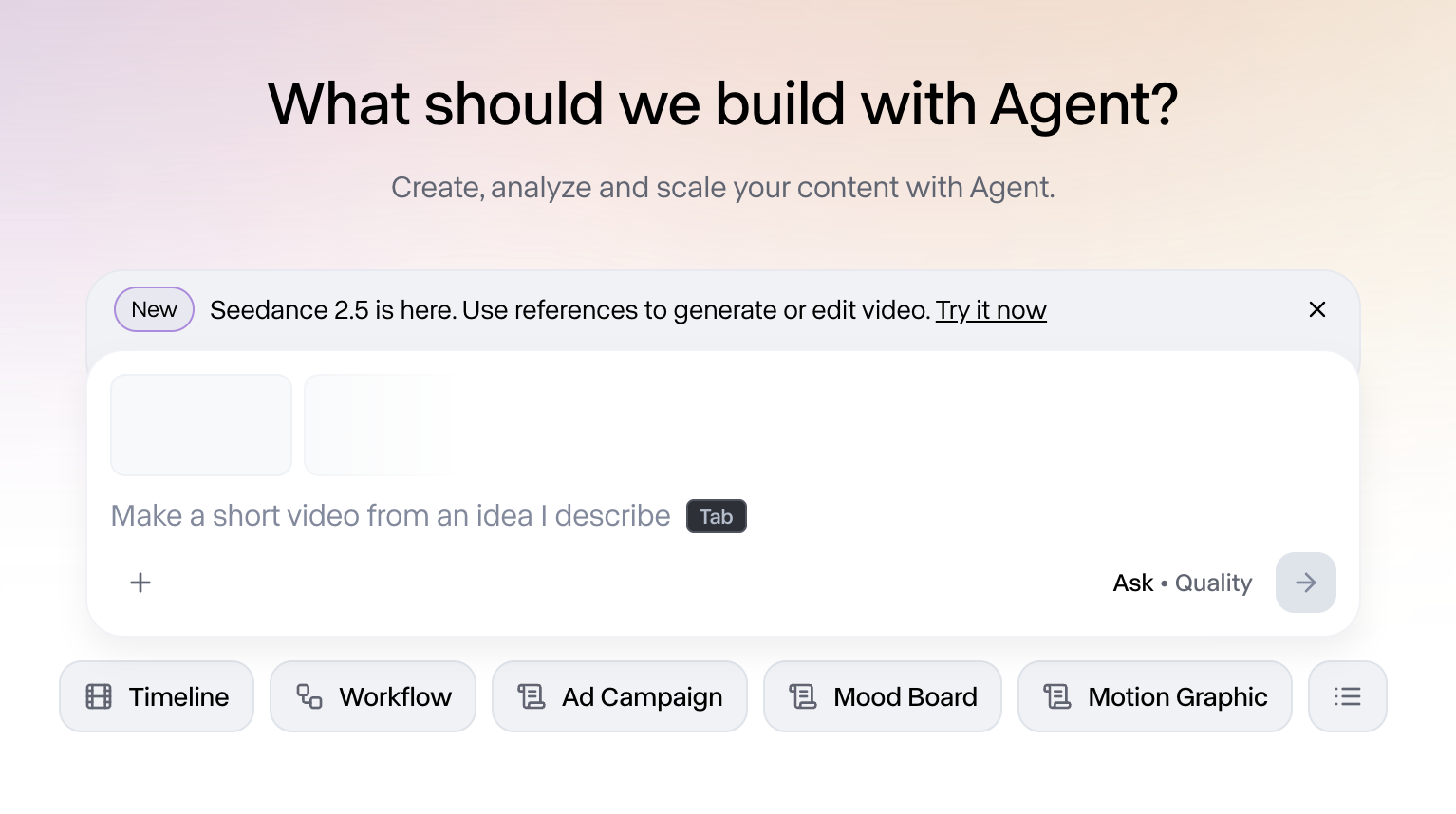
For example, Runway Agent is a chat-based, agentic creative partner that weighs tradeoffs between different generation models and applies that judgment through a skills layer, so users don’t have to manually operate a chain of separate tools. Give it a brief, and it plans, generates and delivers finished videos within a directed workflow, with a person reviewing the output at each step. Additionally, you can define your priority for a task — cost, quality, or both — analyze what’s working and drive better results by uploading campaign data.
Powered by multiple Runway and third-party models, users can generate native audio in the same pipeline as product shots or videos with Agent. The agent also reads the assets you upload within a project and keeps a persistent library of past generations. New features are shipping fast, with the first version of Runway Agent shipping in May 2026, quickly followed by Agent 2.0 the very next month.
Despite automating complex processes in creative workflows, AI agents don’t take the place of human creativity, direction and judgment. In fact, 63% of organizations see using AI as a way to make time for creative work, not replace it.
Ways creative teams use AI agents today
A creative AI agent helps teams across industries like marketing, visual arts, film and media, music, and fashion with:
- Producing campaigns. Generating channel-ready deliverables like TikToks, Instagram posts, or YouTube shorts based on a single conversation about what's launching.
- Optimizing creatives. Diagnosing underperforming content and rebuilding it into stronger versions with new formats and fresh hooks, angles, or ad ideas to experiment with.
- Coordinating in-suite edits. Making multi-step adjustments to content within an existing creative suite from a single natural-language instruction.
- Generating brand-governed assets. Ensuring that new work reflects a team's accumulated brand history and approval patterns to avoid starting fresh every time a brief comes in.
- Scaling across formats. Resizing one piece of creative across each platform's aspect ratio or translating a single asset for every market a brand sells in, rather than remaking each from scratch.
When not to use an AI creative agent
Get more from an agentic creative partner by knowing exactly when to skip it. A person should lead when:
- The work needs a specific human point of view. A campaign built around a director's or artist's distinct voice loses what made it worth doing if a system generates it instead.
- Authenticity itself is the value being sold. A relationship, a business or an audience that specifically values knowing a real person made something loses that value the moment a system produces it instead.
- The deliverable is small enough that directing an agent costs more than making it yourself. Writing a brief, reviewing AI output and revising takes real time. For a single simple asset, a skilled person doing it directly is often faster.
AI creative agents: pros and cons
| Pros | Cons | |
|---|---|---|
| Speed | Finished assets in minutes instead of a full production cycle | Can feel rushed on campaigns that need many rounds of review |
| Cost | Cuts the cost of testing more creative variants before committing | Real integration cost if it needs to integrate with an existing pipeline |
| Consistency | Same quality bar on every generation, even carried into the next project | Can drift off-brand without stored history to check against |
| Creative control | Presents options and variants rather than one fixed output | Still needs a person steering direction and judgment |
| Brand governance | Reads the assets uploaded within a project for brand consistency | Doesn't always carry that context automatically across sessions |
How to evaluate a creative AI agent
- Name the deliverable first. A finished video, a coordinated set of suite edits, a channel-specific ad set and an on-brand asset pulled from stored history are four different jobs. Match the agent category to the job before comparing named products.
- Check what it generates versus what it coordinates. Orchestration agents move existing assets through a suite. Generation-first agents produce the asset. Clarify which one you need, and make sure the option you’re considering is a match.
- Ask what happens with an unfamiliar brief. Some agents lean on years of stored brand history. Others start with fresh brand elements every time. Neither is wrong, but they produce different results on a brand-new campaign.
- Trial two or three before committing. "Agent" quality varies by how much planning is genuinely happening versus how many prompts are chained together behind a single interface. Give each one the same real brief and compare how each performs on your work, and consider the interface if you have a preferred way of building.
- Confirm the format coverage you need in one pass. If audio, video and copy all need to come out of the same pipeline, check that up front rather than after the trial.
The future of AI creative agents
Creative teams are asking agents to hold more of the brief at once: fewer isolated instructions, more systems that plan against the whole goal and adapt as they go. That's showing up unevenly so far.
Some platforms are pulling in more of a channel's own data automatically. Others are folding brand governance directly into generation instead of treating it as a separate check after the fact. And instead of a rough draft that still needs assembly, generation-first agents are producing more of the finished asset with each release.
The categories with the most handoffs today have the most room left to compress: brand governance layered on afterward, audio added in a separate pass. Both keep getting faster and more consistent, which means less time between a first pass and something a team can actually ship.
Runway Agent interface
Frequently asked questions
Why use a creative AI agent instead of a single AI tool?
A single AI tool means a person plans every step and stitches the output together by hand. A creative AI agent takes that planning on for a defined stretch of work, holding the brief in view, generating a first pass, checking it against the goal and adapting without a new prompt at each stage. That's what actually saves time on a campaign with more than one deliverable: fewer handoffs between separate steps and people.
How is Adobe's Creative Agent different from Amazon's?
Adobe's Creative Agent coordinates edits across Creative Cloud apps, so it’s an orchestration system working on assets a team already has. Amazon Ads' Creative Agent is a platform-specific assistant that generates display, video and streaming TV concepts from an Amazon seller's own retail and shopper data.
What's the difference between an AI agent and an AI tool for creative work?
An agent takes a goal, plans a sequence of steps and adapts along the way, delivering a more complete result with less step-by-step direction. A tool responds to a single prompt and typically produces one output.
Where do multi-agent systems fit in, versus a single creative AI agent?
Multi-agent AI usually means several autonomous agents, a planner, a generator and a reviewer, handing work to each other to reach one result. It's an active research area, and recent studies have found multi-agent LLM teams outperforming human teams on creativity benchmarks.
No named commercial creative agent works exactly this way yet. And while Runway’s Agent isn’t a team of agents negotiating a shared task, it chooses among generation models through a skills layer. Adobe’s approach of building a separate, single-purpose agent into each Creative Cloud app, instead of several agents collaborating on one job, is also worth noting.
What's the best AI agent for video generation specifically?
Runway Agent is built for generating finished video directly from a written brief. It handles multi-shot, high-resolution video in minutes, automatically choosing from models like Gen-4.5, Aleph 2.0 and Seedance 2.5 depending on the task. It’s a powerful tool for creating anything from static images to ad campaigns, sizzle reels, social posts, commercials, and more.
If you want audio, copy and video coordinated in a single pass, build on the agent’s output with other features like image creation and adding dialogue in Runway’s creative workspace. And if your goal is a brand memory layer you can refer to for new assets, upload past outputs along with a text prompt to guide the agentic AI.
For years, creative production has been about how many separate tools a brief has to pass through before it becomes a finished asset. The next improvement hinges on giving the brief straight to a generation-first agent and letting it get to work. Get started for free today.
Related: Generative AI for marketing: where it actually pays off, by function | AI for product marketing | AI-generated commercials | Creating with Runway Agent