Skyscanner helps millions of travelers plan and book trips across more than 180 countries. The brand marketing team responsible for how Skyscanner shows up in the world is a group of around 45 people: designers, motion designers, copywriters, producers and campaign managers. Led by Andre Le Masurier, Global Executive Creative Director (ECD) of Brand & Creative, James Bradley, Principal Brand Design Lead, and Julia Doogan, Senior Brand Designer, are among the team responsible for ensuring every piece of work scales consistently across Skyscanner's global marketing campaigns.
Most recently, that meant rethinking how the team prepares for a major brand shoot. For Skyscanner's U.S. and Canada brand campaign, the team used Runway to support the art direction: locking in shot compositions, lighting direction and actor staging before stepping onto set, then validating what they captured live. In this conversation, James and Julia walk through how the workflow came together, what changed when they stopped guessing and where Runway fits in the team's work going forward.
Pinpointing Use Cases
When did the team start exploring AI, and what pushed it forward?
JB: We're quite a forward-leaning team that’s always trying to keep up or stay ahead. Runway was probably the first tool we brought into our armory. We had one person internally who started spending weekends playing with it, and that seeped in and positioned why we should use it.
We've primarily been using it to help inform art direction: mocking up thoughts, mood boards and creative concepts in a realistic way so we can align stakeholders and get business investment before we go and create things in the real world. Our campaigns run for a full year, so what we capture on a shoot has to last. From a single shoot, we're creating still content for everything from out-of-home (OOH), Meta ads and onsite placements. On set, we had roughly 20 minutes per day across a four-day shoot. Before Runway, I'd spend two weeks before the shoot, maybe longer, just documenting my thought process. I wasn't really experimenting with what I was creating.
“Before Runway, I'd spend two weeks before the shoot, maybe longer, just documenting my thought process. I wasn't really experimenting with what I was creating.”
Using Runway for Pre-Production
Walk us through how you're using Runway to prepare for photo shoots. How does it fit into your pre-production process?
JB: For our U.S. shoot this year, we used Runway to inform how we were going to stage the actors, how we were going to light the scenes, things of that nature, to get buy-in from Andre, our Executive Creative Director, and other stakeholders. That way, we could optimize our time spent on shoot. We started taking talent or reference images and pushing how we composed them. Using Runway, we generated the environments we knew we'd be shooting from the television commercial (TCV) scripts: a bar, a spa, a beach and a hotel balcony — all of which were going to be built on a soundstage in the middle of winter in Utah. Runway let us show the photographer exactly what light quality and color we were after before she arrived.
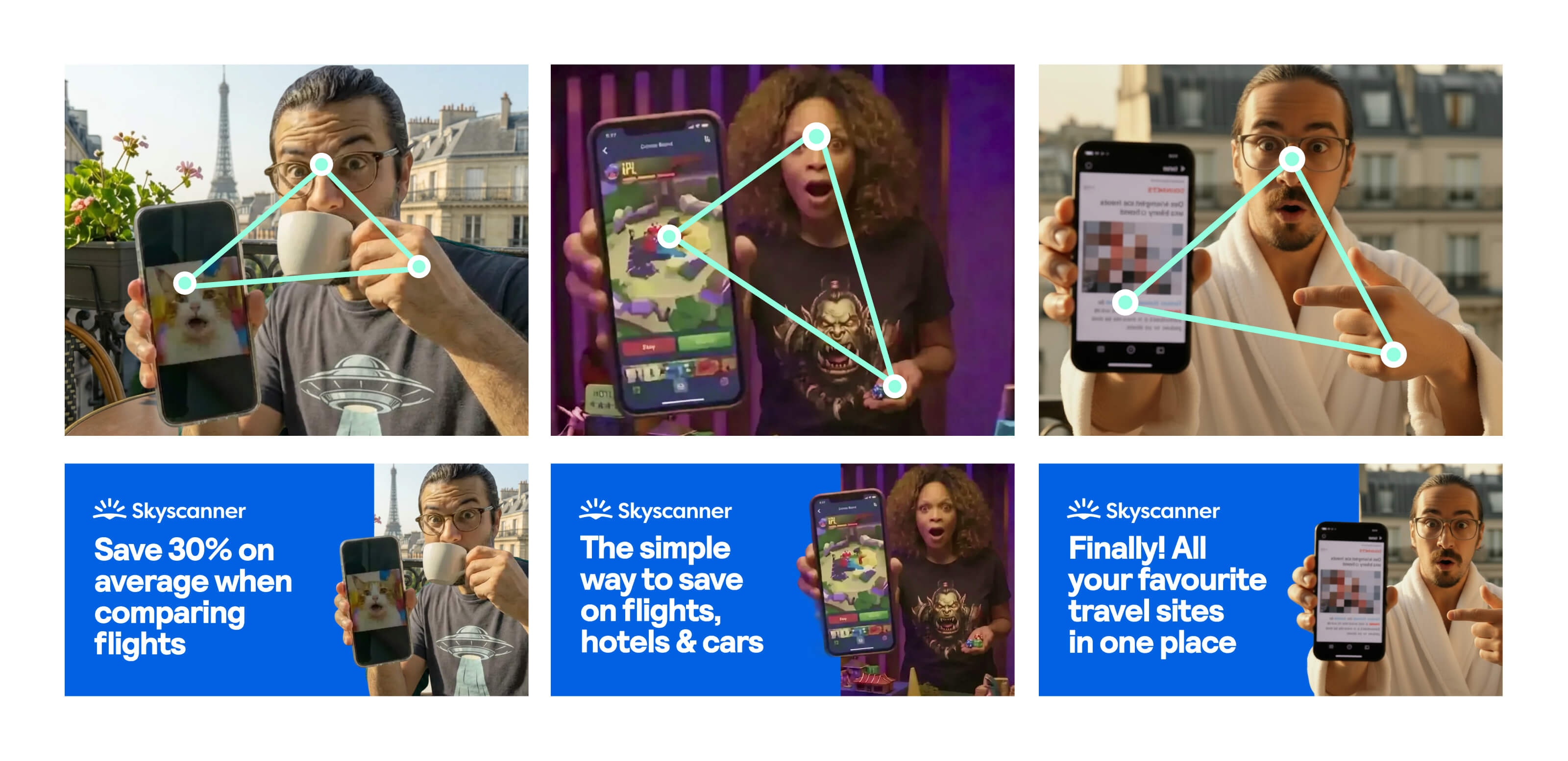
JD: Styling and poses were a big part of it, too. Skyscanner's ads are about capturing a moment, so we wanted it to feel candid and authentic and for that to come across naturally. Props were another focus. Someone gesturing to a phone isn't enough. We worked through a lot of those details in Runway too, including the triangle compositions we'd refined over four years of testing in Canada. We’ve learned having the phone large and close to the face, with a tertiary gesture or prop, helps to retain visual attention in large-scale OOH placements.
JB: Everything was laid out into final ad formats — OOH, Meta, lower funnel — before a single day of shooting. Andre had a clear vision of what we were going for. That alignment is critical for us because we can't go back. A year-long campaign has to be locked before it's shot.
How did Runway factor in once you were actually on set?
JD: We'd agreed on inventory going in and could immediately check whether what we'd just captured matched it by dropping the raw image feed into the pre-approved layouts in real time. That closed a feedback loop that used to stay open until post.
JB: We also shot a lot on blue screens, so we used Runway on set to quickly generate temporary backgrounds. If we knew a scene was set on a beach in Hawaii, we'd drop in an AI-generated background behind the talent so we could validate that the wardrobe and props were reading correctly. These were never meant to be the final backgrounds; we just needed to confirm we were capturing the right things while the talent was still there.
JD: The final result wasn't far removed from everything we'd planned with AI. The actors are different, the sets are slightly different because you're in the real world, but the gap between what we'd pre-visualized and what we captured was really small. Every minute counts on the shoot, and we had very few minutes. Going in well equipped made it feel a lot smoother and helped us act with confidence.
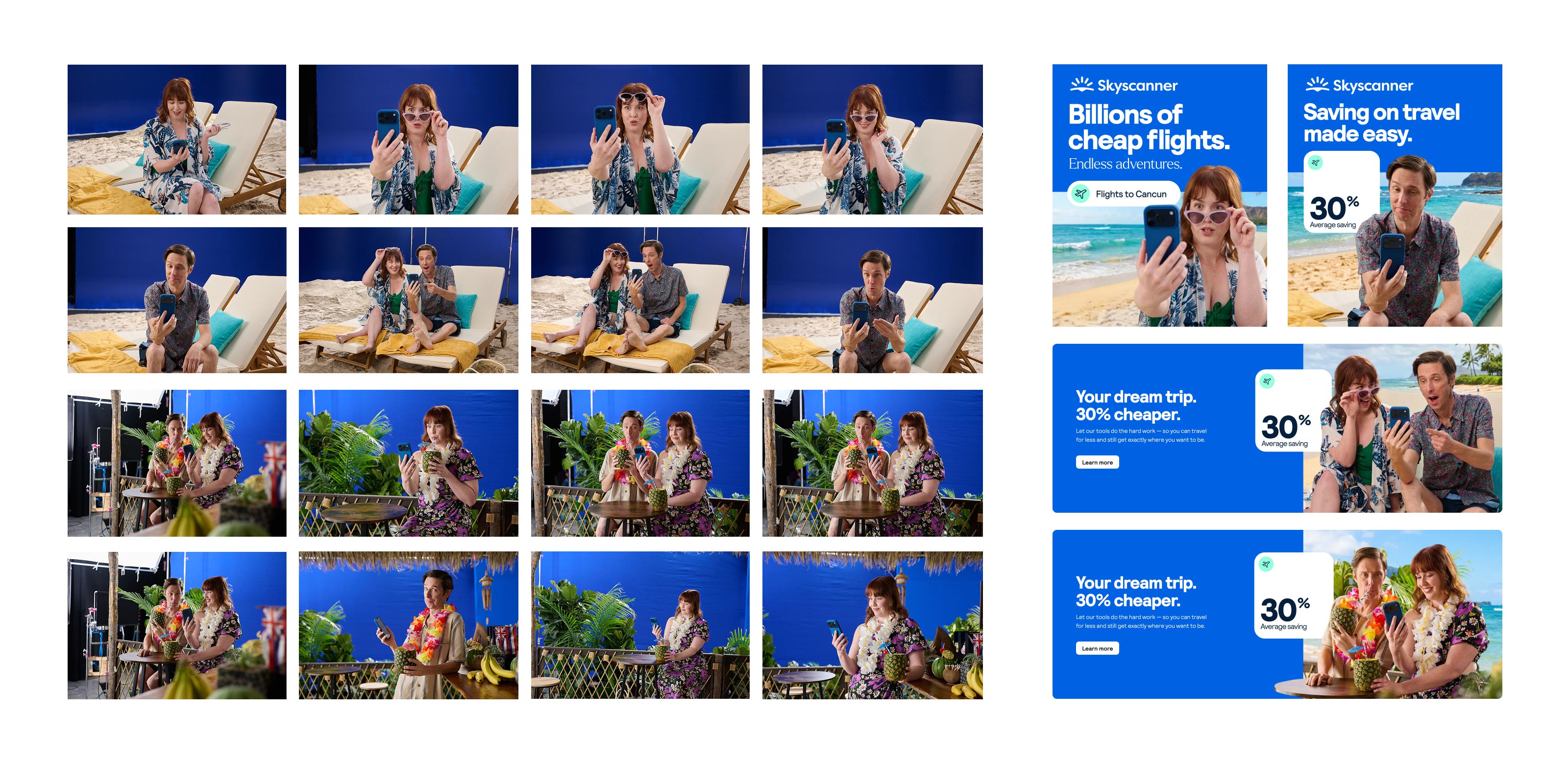
Raw image feed (left) fed into pre-approved layouts (right)
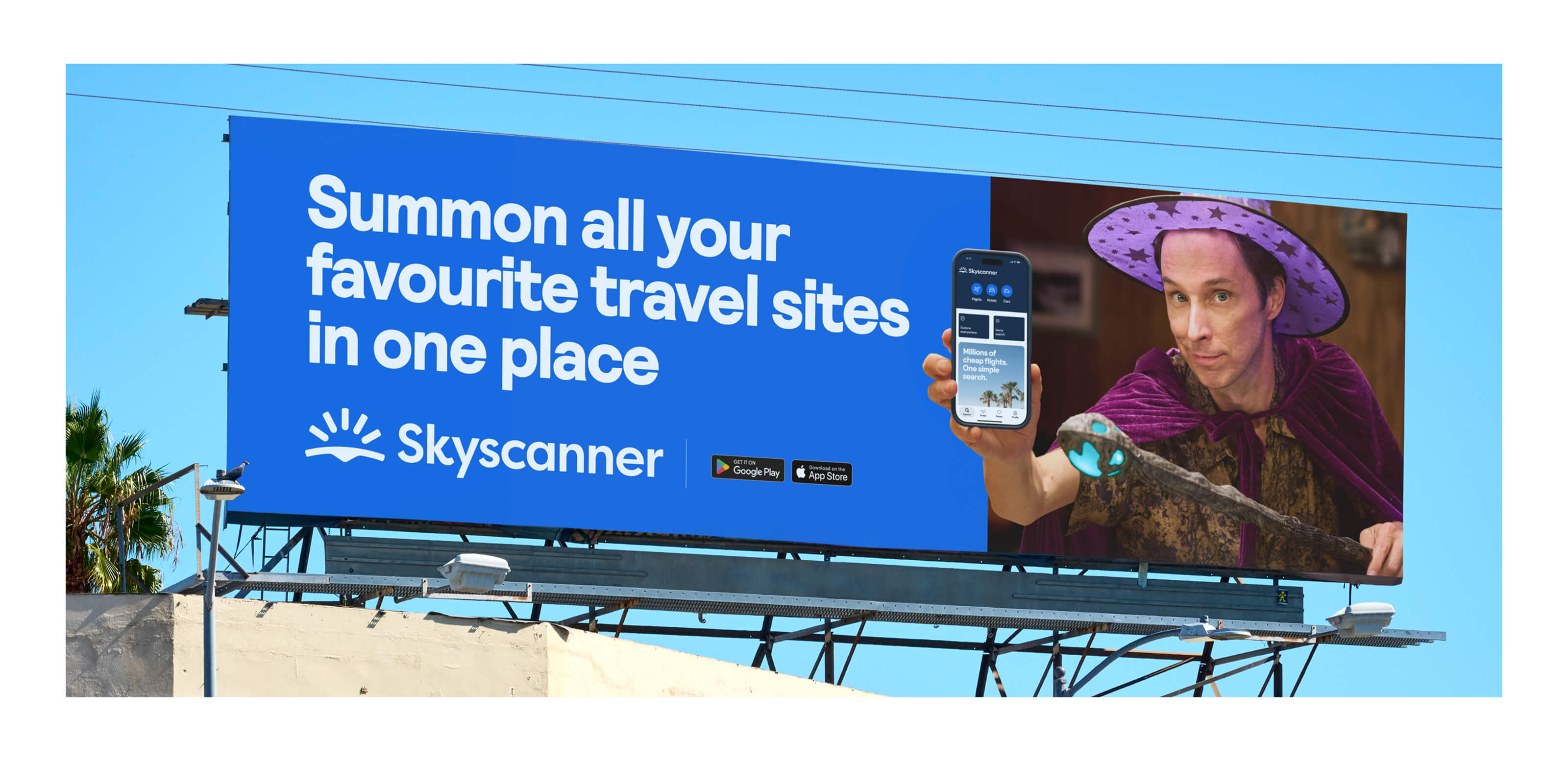
Final billboard ad for Skyscanner’s U.S. & Canada brand campaign
Considerations and What’s Next
Are there any challenges unique to creating travel content specifically, things like portraying destinations and travelers across the world, that have come up as you've leaned into AI?
JD: There's tension there. Using AI to inform how you’ll capture shots of real people, that's one thing. But the tension is you're selling destinations, and you don't want to misrepresent that.
JB: Travel is an important investment, and travelers want to get it right. As a company, we do not want to mislead people with how we represent the travel experience. We deploy AI in the right spots: during pre-production and on set to validate our human-led art direction. This amplifies craft and helps us capture the real world. It’s not in the final creative that goes out into the world, and we’re not creating an illusion or something that doesn't reflect reality. For the U.S. and Canada campaign shoot, we were representing actors in controlled environments on blue screens, so using AI for pre-production made sense. If it was more destination or prop-led, we probably would’ve had a different conversation.
“Travel is an important investment, and travelers want to get it right. As a company, we do not want to mislead people with how we represent the travel experience.”
What are you planning to explore next with Runway?
JB: I'm really interested in Workflows. We've spent a lot of time establishing our brand world and scaling it across key markets. Now, I want to know where Runway can fit in to push and enhance that. There are parts of our production phase where AI can absorb the more routine work, and that frees us to keep pushing up the value chain on the art direction side.
JD: For me, it's about asking how do I make the best work with my craft, and then how do I speed up the things that slow me down. Rather than just focusing on one model or one approach, I'm about challenging myself to keep opening up and pushing what's possible.