Today, we're launching Runway Media Router, the world’s first model router for generative media models. Media Router is a new capability in Runway Dev that automatically selects the best video, image or audio model for every request. Until now, media has never had an equivalent to intelligent routing for LLMs, largely because video, image and audio models vary so much in what they can actually produce. Our Media Router solves this by matching a request to a model’s capabilities and modalities, then optimizing across the qualifying models for the cost, quality and latency preferences you set.
Historically, every generation request meant hand-picking a model and manually updating that choice every time a new model launched, pricing shifted or you switched to a different medium. Media Router removes those steps, letting you configure what "best" means for your use case once, and making it easy for you to evaluate and enable new models as they are released.
The Problem With Picking Media Models Manually
Runway Dev's core value is giving users access to the world's best media models on one enterprise-grade platform. That means first-party access to Runway's frontier models, including Gen-4.5, Aleph 2.0 and Act-Two, alongside the best third-party models, including Seedance, GPT Image 2 and ElevenLabs. But having every new model on day zero has also become a source of friction. Builders tell us they don't want to become part-time model researchers, tracking which model is fastest or best suited to a given style, and re-litigating that choice every time the catalog changes. We often see teams pick a model once and stick with it long past the point it's the right call.
At enterprise scale, this gap compounds. A model that's a bit pricier or a bit slower may not matter on a single request, but multiplied across thousands of generations, it becomes a real cost and latency drag that blocks scaling. Smart routing is well established for enterprise LLM usage, but we think it matters even more for generative media, where quality is a far more complex dimension than it is for language.
How Media Router Works
Media Router replaces manual model selection with three steps:
Set your preferences. In the Runway Dev portal, select optimization preference between cost, latency and quality. Name your config, set a price cap, allow or deny different models or providers and optimize between your preferences. Save it once as a reusable config tied to a specific workflow, like a fast in-app preview versus a paid final export.
Call one endpoint. Send your generation request to the Media Router endpoint with your config ID attached. No need to specify a model.
Get the best model. The router filters out any model that fails your hard constraints (capability fit, allow and deny lists, price cap), then scores the remaining models against your cost, quality and latency preferences. It generates with the highest-scoring model and returns the result along with metadata identifying exactly which model was used and why.
The initial config dimensions that will ship today are:
- Price cap: a hard ceiling per generation, in USD per second for video or per image for image models
- Allow and deny lists: provider and model-level rules that restrict routing to approved options
- Set preferences: define your preferences across cost, quality and latency optimization
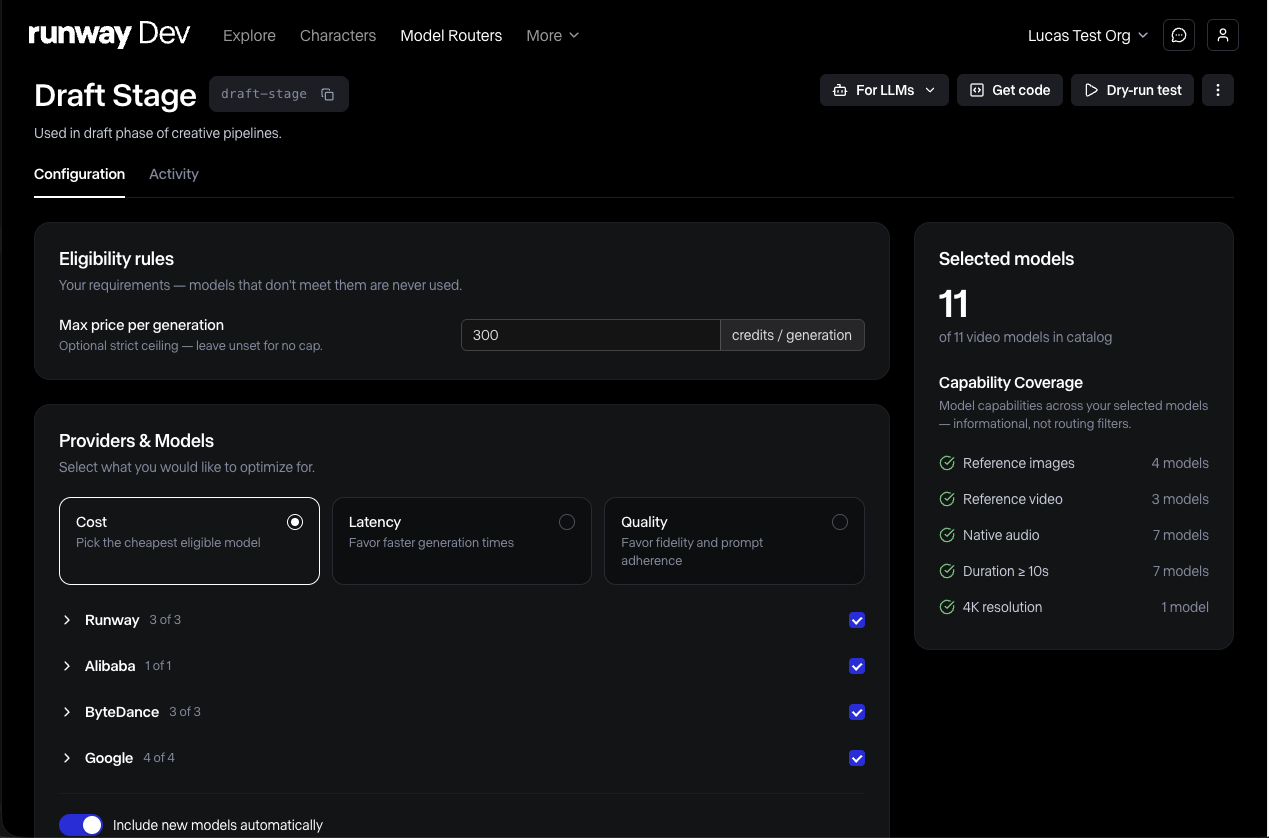
If a request can't be satisfied by any model under your constraints, Model Router returns an explicit error naming which constraint emptied the pool, rather than silently downgrading your settings. And before you put a config into production, a dry-run flag lets you validate exactly which model it would select and why, with no cost incurred and nothing generated.
Media Router Scales With Your Team
Scale changes what a model choice actually costs: in dollars, in latency and in oversight.
For teams running high request volumes, small differences add up fast. A fraction of a cent or a few milliseconds of latency, multiplied across a million requests a year, becomes a material cost. Media Router also solves a real integration problem: keeping up with a fast-moving model catalog without constantly updating your code.
Try Media Router Today
Media Router is live now for video, image and audio models in Runway Dev. Start building at dev.runway.com.