
40 years
of video games serving as the proving ground for modern AI
60 frames per second
the real-time bar AI must clear inside a game, synchronized across thousands of players
Modern AI grew up inside video games. For four decades, they've been the proving ground where the technology learned to work. Now, Electronic Arts (EA) Chief Strategy Officer Mihir Vaidya argues the industry that trained AI is charting how generative models earn their place inside experiences that have to respond to millions of players, sixty times a second, without ever breaking. He laid out where that frontier actually is — and it isn't where most people think.
Games Built AI Before AI Rebuilt Games
“It's under-appreciated that games have very much been the proving ground for AI for the field's history,” Vaidya says. “If you zoom out and look at the last 40 years, a lot of what powers modern AI has its roots in video games: GPUs, agents that have learned [reinforcement learning] in interactive environments.”
That history shapes how he sorts the current moment. The AI games have always run on — “procedural generation, [non-player character] logic, behavior trees, matchmaking systems, basically systems that are deterministic, reliable, controllable” — sits at one end of a spectrum, and generative AI sits further out along it, meaningfully expanding what's possible for both developers and players.
What he resists is the industry's instinct to hand everything over to neural networks: “There's this orientation towards neural everything,” he says. “And I think that's a little bit simplistic.”
Some parts of a game simply can't be probabilistic. “You don't want the rules of basketball suddenly just being determined probabilistically,” he says. “You don't want the physics of an F1 car to be hallucinated either.” The frontier he's watching isn't generative AI at all, but what comes after it: “a neuro-symbolic architecture that gives you the benefit of generative systems that are truly emergent... but also gives you the benefits of determinism and control and reliability.”
The World Has to Respond to You
Games are unlike any medium AI has entered before because the audience doesn't sit on the other side of the screen. It's inside the world, playing. “If you're watching a movie or a TV show, you don't, as a consumer, expect for the world to respond to you,” Vaidya says. “But in games, they have to respond to you.”
And the response has to survive a stack of constraints no film ever faces: continuous input from players, deep interactivity, synchronization across thousands of people playing together and latency that never lets up. “60 times per second, endlessly, for many, many, many hours,” he specifies. A racing game makes the difference concrete. On screen, a car bending around a curve just has to look right to satisfy an audience. “In a game, you need for the drag coefficient on that wheel to be felt by the player,” he says. “It can't just look right. It has to behave right.”
Deploying AI in games, then, is “not just solving a content generation problem,” he explains. “You're actually solving a complex systems coordination problem.” The bar, in his sharpest formulation: “It's not enough for things to look real. That's what you would call a dream. It has to be real, which is what you'd call a simulation.”
Control Is the Next Frontier
For Vaidya, framing AI in games as an efficiency play is “a very reductive kind of construct.” He starts from first principles instead. “The origin of creativity is very much the human mind: ideas, intuition, taste. It doesn't originate on a piece of paper or on the screen or some other tool.” From there, “the business of creativity at large is a quest to close the gap between imagination to creation,” and tools exist to widen and smooth that bridge.
The gap he most wants closed is control. Today's generative models can render almost anything, but they don't yet understand a particular studio's intent or aesthetic style, and that shows up in the output. “They can often produce very, very pretty pixels. They just don't feel like the right pixels,” he says.
Computer graphics historically solved this in the opposite order. “You started with these very foundational building blocks where you can exercise a ton of control, and then you solve for fidelity” — polygons, then meshes, textures and lighting. Generative AI arrived backwards: “Today we have these models that can produce these incredible, super realistic outputs, the highest levels of fidelity. But you don't have those baseline primitives to work with to exercise control.”
That inversion defines the work ahead. “Control is very much the next frontier,” he says, and crossing it will take deep customization and workflow collaboration between studios and the companies building the models.
Beyond a Trillion Permutations
EA sorts AI's impact into three horizons — efficiency in how games get made, expansion in what games can hold, and transformation into "entirely new forms of entertainment that we probably don't have names for yet."
Expansion is where the player-facing promise lives, and The Sims is the clearest preview. Coming up on its 25th anniversary, the franchise has engaged over 500 million players. No two players have had the same experience because “there's almost a trillion different permutations of how you can play through the game.” AI blows past even that ceiling: “Even with the trillion permutations, there should be a trillion to the trillion to the trillion to the trillion possibilities of what is possible in The Sims.”
Transformation is harder to picture. When YouTube and the smartphone arrived, traditional entertainment worried that “everyone can now be Steven Spielberg,” but the reality turned out quite different. “There's still only one Steven Spielberg. But there are all these incredible creators who honestly shaped new forms of entertainment that we didn’t have names for at the time.” He expects the same pattern will manifest in games where it reaches a level of value creation we've never seen before.
Modernizing Twenty Years of Assets
Vaidya's favorite proof of AI's impact is one he introduces as a “slightly potentially boring example.” EA's biggest franchises — FC, Battlefield, Madden, The Sims, Skate — span decades, which means their asset libraries predate physically-based rendering (PBR), the technique that makes light bounce off surfaces realistically in modern games.
“We're now able to leverage AI to modernize these assets and bring them into PBR pipelines,” he says, “which would have taken armies of folks to do in the past. And honestly, it's not something you can prioritize in the context of all the things you have to do as a game developer.” The payoff is scale: “It meaningfully expands the nature of the worlds that we have because there's so many more assets that can be part of the mix.”
Planning for the Exponential
Vaidya studied math under Geoffrey Hinton and the founders of modern AI, and it left him with a conviction that exponential technology can't be planned in the present tense. “You can't just think about it in the now and today, but very much have to think about it in the future.”
His strategy runs on two axes: what will change and what won't. On the first, the three horizons run in parallel: "Efficiency may be more near-term, expansion of games may be more mid-term, and transformation of games altogether will be longer-term... they have to exist in parallel as opposed to sequentially, just given the lead times involved."
The second axis is the one he refuses to let AI overshadow. “It's also equally important to think about what won't change, what is timeless, despite AI,” he says. “The value of IP and brands, the importance of communities and network effects, the criticality of global distribution, localization, culturalization — all of these actually arguably grow in importance.”
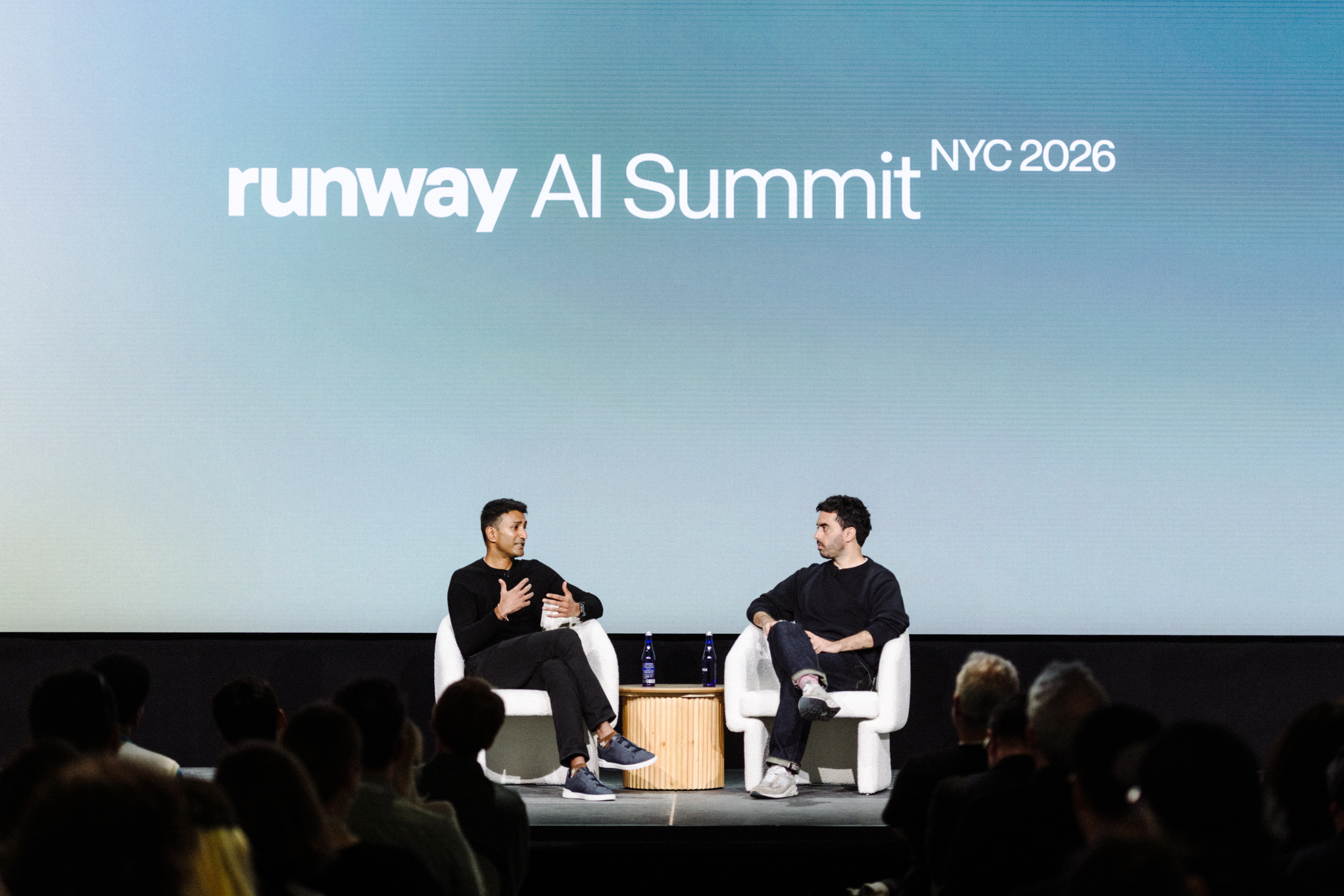
Based on a conversation in New York City with Mihir Vaidya, Chief Strategy Officer at Electronic Arts, during the 2026 Runway AI Summit.