How Populous Brings the World's Most Iconic Venue Designs to Life with Runway
of render time reallocated for strategy, research and design
2 weeks
active projects using Runway
30+
of EMEA staff create in Runway
25%
Georgina Myers is a senior associate and architect at Populous, a global design firm that has spent four decades designing the spaces where the world's biggest shared moments happen, including Wembley Stadium, Tottenham Hotspur Stadium and the Sphere in Las Vegas. She is a senior designer on a portfolio of stadium projects in the Middle East, including MBS Stadium in Saudi Arabia, a futuristic stadium built on the edge of a cliff (currently under construction). She also serves as Populous's EMEA representative on its global AI working group, where she co-authored the firm's AI governance policy.
In this conversation, Myers walks us through how Populous uses Runway as a tool to assist its concept design process, the team workflows that have scaled around it and why faster visualization has freed up more time to design in detail.
The Problem with Visualizing at Stadium Scale
You were experimenting with AI tools well before most architecture firms. What first drew you to them, and how did that shape the way you think about these tools today?
It goes back to my university thesis. My research question was: can AI be creative? As part of that, I built my own version of an attention GAN, a generative adversarial network, trained on images of buildings and interiors. The outputs weren't amazing. But what struck me was the structure of how GANs work. The model generates something, it critiques itself and it goes back and iterates. That felt so much like how design actually works.
For me, that really cemented this idea that AI and humans need a co-creative process: working through it together, not one replacing the other. The way we used it early on was to build a narrative. A huge part of designing a stadium or an arena isn't just the geometry but rather, asking “What does it feel like to be in this space?” AI imagery alongside sketches helped us capture those different experiential moments, and that narrative drove the actual 3D form work.
“For me, that really cemented this idea that AI and humans need a co-creative process: working through it together, not one replacing the other.”
Concepting and Rendering with Runway
What does it take to visualize a project at the scale Populous works on, and when did Runway start making that possible?
We work on massive venues: stadiums, arenas, airports. To do those projects justice visually, you need a tool that can hold context at that scale: aerial views, full stadium bowls, tens of thousands of seats in frame. For a long time, that was the hard part. AI would lose its sense of scale completely on those shots. It was excellent for facade close-ups and interior moments, but it couldn't read a full bowl correctly.
Around six to twelve months ago, that changed with Runway, and it opened everything up. We are not using it to create actual designs, but rather, to create full renders and aerial shots that actually convey the scale of our designs and what we're building. Runway gets me to the output I want faster than other platforms I've used, and I can flip the UI from quick one-off generation to a fully-structured workflow depending on what I need. That flexibility matters a lot when you're moving fast on a competition to win a project.
“Now we can do full renders and aerial shots that actually convey the scale of what we're building.”
What does early-stage design with Runway actually look like for a venue project?
The biggest use case is what we call Stages 0 to 2: ideation through concept. We're trying to help clients feel the spaces: the materiality, the atmosphere, what it actually feels like to be there. I'll bring in eight different images and describe what I need from each: “keep the geometry from this one,” “take the lighting from this one,” “pull the crowd energy from this one.” Even with that level of complexity, Runway puts something coherent together.
Our venues are multi-use. One night there'll be a football match between Chelsea and Arsenal, and three nights later there will be a Taylor Swift concert. You write a prompt that says, "FIFA World Cup, South Korea is playing Argentina," and the image comes alive in a completely different way. You give it a story, and it encapsulates that story in the image. Having Runway to iterate through what the space looks and feels like for each user group, especially for a project like MBS Stadium with 9 different event modes, has been really invaluable.
What Faster Visualization Freed Up
What did this kind of visualization work look like before, and what has actually changed?
A full video would take at least three weeks with an external render team. Anything else was a Photoshop collage, which meant there was a real ceiling on what you could achieve.
One of the biggest shifts is competition work and the reality of deadline constraints. We used to have to freeze our design models over two weeks before submission so the render team had enough time to turn things around. That's two full weeks where we had stopped designing. By reducing the time spent creating visuals, Runway gives us more time to focus on the design itself.
This addresses a question people often ask: if everything gets faster, does the quality go down? For us, it's been the opposite. The speed gives us back the time to do the more important work of designing how the spaces actually work in detail.
Runway also gets our designers and clients to a shared vision of a project much quicker. Designers often carry grand visions in their heads. Communicating those visions accurately, and bringing clients along on that journey, has traditionally required a lot of time and effort. Now, the process is much more streamlined.
“By reducing the time spent creating visuals, Runway gives us more time to focus on the design itself.”
Beyond your own work, what workflows have scaled the most at Populous?
The first is in our in-house Experience Studios group, where part of their team produces some of the animations and renders for projects. They use Runway Workflows to maintain visual consistency across everything produced for a single project. When you're producing renders and animations across a full competition submission, everything needs to feel like it came from the same world. Workflows make that repeatable.
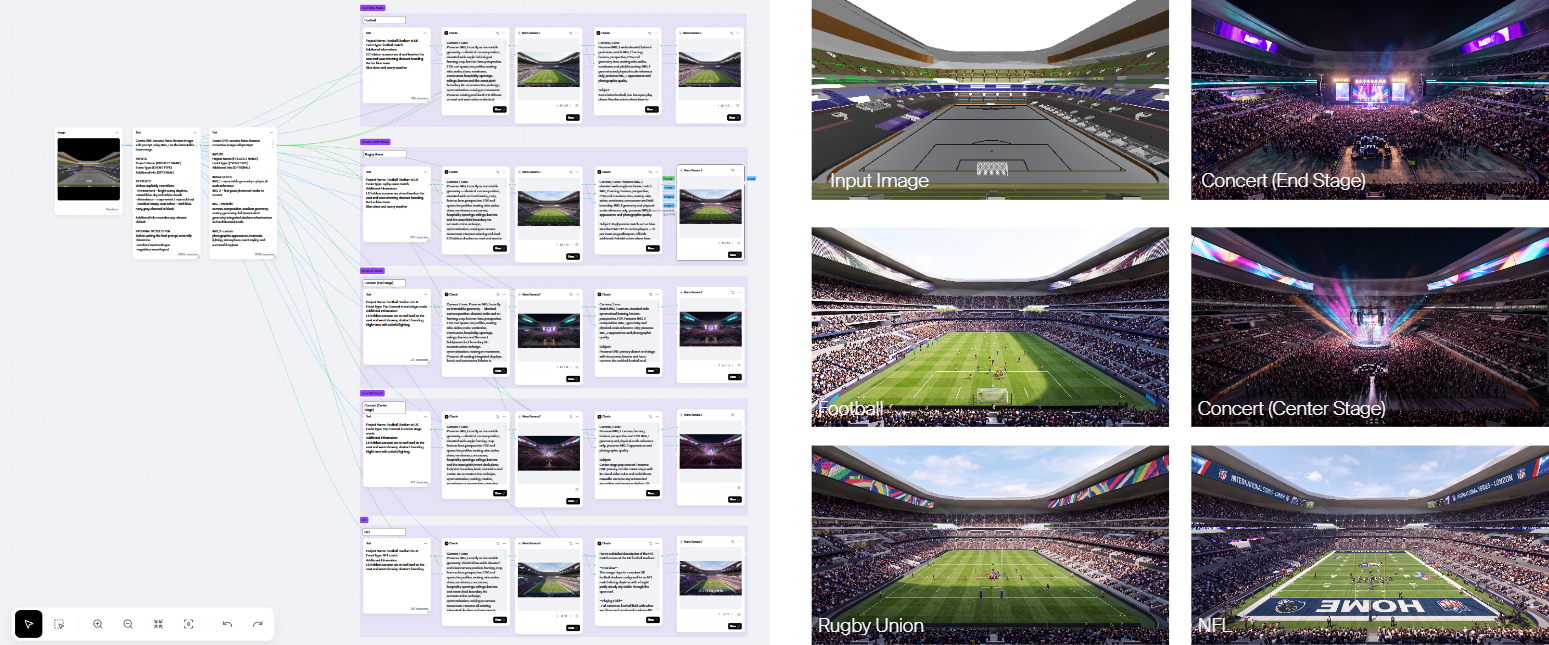
The second is our Populous Strategy team, who build the branding and concepts for hospitality spaces inside our venues. They use workflows to create a cohesive brand identity — mood imagery, close-up details like the design of a lounge or staff uniforms, the feel of different spaces — and then apply that visual language on top of V-Ray renders. Before, all of that overlay work was being done in Photoshop, piece by piece, with stock imagery. Now, they can bring a brand to life consistently across an entire venue within the time they actually have.
How did Runway go from something you were testing to something the whole firm was using? Do you see your industry as a whole following this trajectory?
There was a massive influx of demand and excitement internally, the same wave you see when any major tool breaks through. But we were careful. I'd heard stories at other firms about confidential work ending up in the wrong places with other platforms, so protecting our clients' IP and our own design IP was non-negotiable. We needed to be in an enterprise agreement with the right company before we could open this up to the whole firm. Once we had that, adoption was almost immediate.
On the industry piece, I think anyone not moving in this direction is falling behind. Client expectations have shifted, fees are more competitive, and clients expect more renders. I see it when I look at which architecture practices are using AI visualization tools: it's the major firms. I think it's the direction of the whole industry.
“I think anyone not moving in this direction is falling behind.”